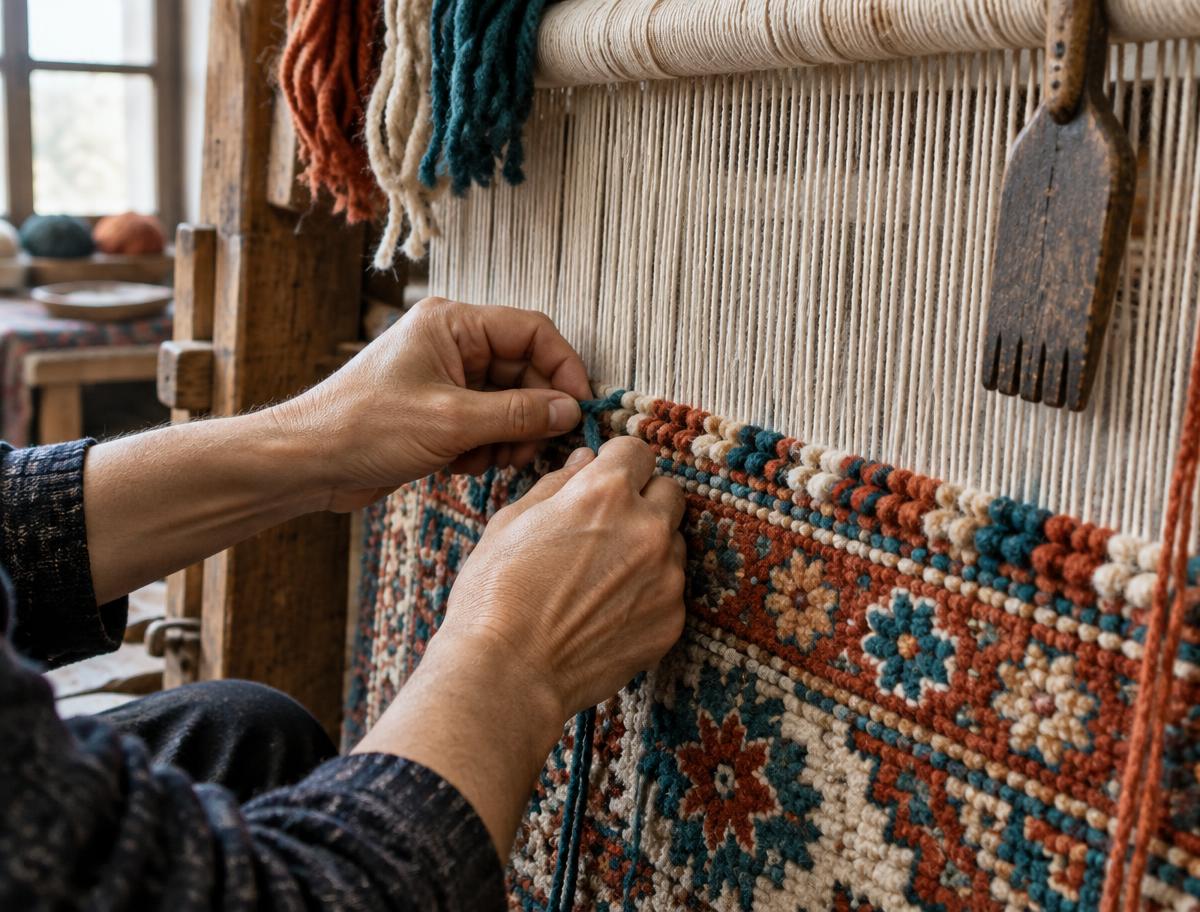
Fibre, yarn & dye
A rug begins with its materials. Wool is cleaned and spun into yarn; silk and cotton may serve different roles in the pile or foundation. Yarn can be coloured with natural or synthetic dyes. Neither label alone establishes quality: dye stability, fibre quality, preparation, and the way a piece has aged all matter.
The foundation on the loom
Warp threads run along the length of the rug, held under tension on a loom. Wefts pass across them to create and secure the structure. In a piled rug, knots are tied around the warps and held in place by rows of weft. The fringe of many hand-knotted rugs is the exposed continuation of the warp, not a separate decoration sewn on afterward.
Knotted & flatwoven
Hand-knotted rugs are built knot by knot. Symmetrical and asymmetrical knots are two common structures, with variations across weaving traditions. Flatweaves such as kilims create pattern without a standing pile, through the relationship of warp and weft or supplementary yarns. Tufting uses a different process and is not the same as hand-knotting.
Finishing & what quality means
After weaving, a rug may be sheared, washed, stretched, and have its ends and edges secured. Knot count influences how finely a design can be drawn, but is not a universal score of excellence. A loosely knotted village rug can have outstanding colour and character; a densely knotted rug can still have poor materials or uninspired drawing.